



False memories throughout adulthood
Photo by Andrea Piacquadio on Pexels.com
The adults project’s main goal is to study the impact of the availability of articulatory rehearsal and attentional refreshing on the formation of false memories during aging (please refer to the “Projects context overview” page for further details on these two mechanisms).
Expected results
Since attentional refreshing is usually impaired in aging, we expect to see an increase of long-term false memories in the older adults group (60-75 years old) compared to the younger adults group (18-30 years old). By contrast, we do not expect to see a difference between these two groups for short-term false memories, since articulatory rehearsal is well preserved in aging. In order to test these hypotheses, several studies will be carried out.
Method
The experiment will be presented to subjects, from both the younger and older adult age groups, on a computer. Based on a Brown-Peterson task (Brown, 1958; Peterson & Peterson, 1959), the aim of the experimental task is to memorize several items while actively taking part in a concurrent task before recalling all the items at short- and long-term. The items used will be lists made of 4 words more or less semantically linked between them. These lists will be chosen from a larger dataset of lists created by Bonin, Méot, Ferrand, & Bugaïska (2013). The structure of a single list is as follows: each list is made of a main theme word and 4 words described as semantic associates to the theme word. For example, for a list in which the main theme word is « lettuce », the 4 semantic associates that make up the list, and that the participant is instructed to memorize, would be: « salad, turtle, green, garden ».
In order to test our hypotheses, we will manipulate the availability of both working memory mechanisms previously described: articulatory rehearsal and attentional refreshing. The availability of attentional refreshing will be manipulated using a concurrent task. This concurrent task will either be a low cognitive demand task in order to allow the use of the memory mechanism, or a high cognitive demand task to block it. As for articulatory rehearsal, we will either give no particular instruction to participants in order to allow this mechanism during the concurrent task, or instruct them to repeat a set of 3 syllables out loud during the concurrent task in order to block the use of the mechanism. Once the concurrent task is over, the participant will be asked to recall the words from the main memory task at short-term and then later at long-term. (See Figure 1.)
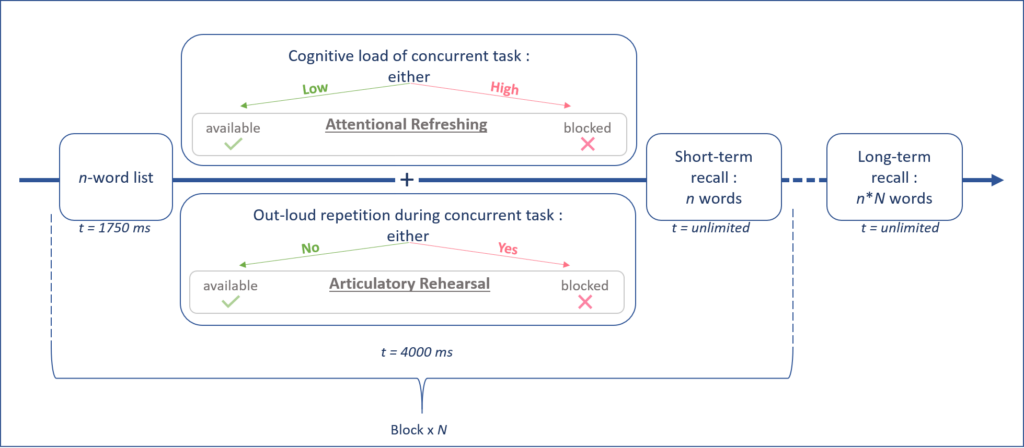
Several studies following this general experimental procedure will be carried out. The nature of the concurrent task and its level of cognitive demand will vary according to which mechanism is being studied in a given experiment.
Application
This project is an important challenge not only for theoretical research, but also for any applications in rehabilitation and cognitive stimulation in old age. In addition, FALSELIFE has the potential to offer new methods to help those most vulnerable to resist memory distortions by improving WM maintenance and maximizing verbatim accessibility.